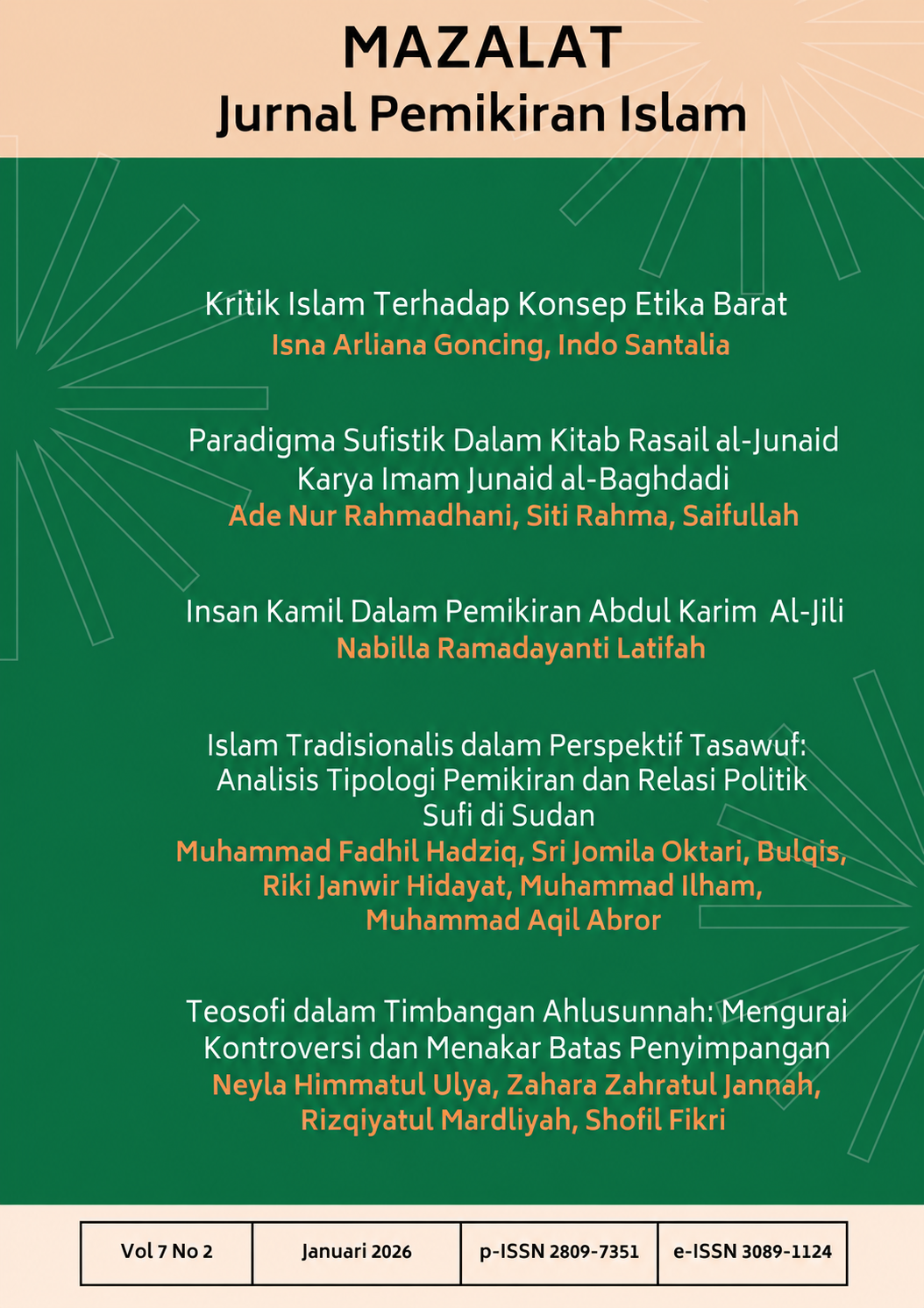
Islam Tradisionalis dalam Perspektif Tasawuf: Analisis Tipologi Pemikiran dan Relasi Politik Sufi di Sudan
Abstract
This study stems from the importance of typologies of Islamic thought in understanding the dynamics of tradition and change, with a focus on Sufism as a representation of traditionalist Islam in the Sudanese context. The aim of this research is to identify the typology of Sufi thought, analyze its characteristics, and examine its relationship with social and political aspects. The method employed is descriptive qualitative research through a literature study, with content analysis combined with historical and conceptual approaches to primary and secondary sources. The results indicate that Sufism in Sudan represents a form of traditionalist Islam rooted in turāth (classical tradition), the authority of scholars, and the practices of ṭarīqahs, while also exhibiting moderate, tolerant, simple, and socially adaptive characteristics. Beyond being a spiritual system, Sufism also functions as a social force in education, conflict mediation, and the shaping of community morals, and it maintains a dynamic relationship with politics that includes patterns of engagement, co-optation, and resistance. In conclusion, Sufism in Sudan represents “dynamic traditionalist Islam,” which not only preserves the continuity of tradition but also actively adapts to and contributes to contemporary social and political life.
Downloads
Published
How to Cite
Issue
Section
License
Copyright (c) 2026 Mazalat: Jurnal Pemikiran Islam

This work is licensed under a Creative Commons Attribution 4.0 International License.